THE KEY QUESTION IN SALES RECRUITMENT
Are you hiring the best intervieweeorthe best salesperson?
Sales experience, a convincing presentation and a good rapport in the interview do not yet tell you whether a candidate will meet the targets set by your sales leadership.
Before you hire, SalesDNA X-Ray identifies the factors that support or limit a candidate's sales performance in the role you are offering.
Skill tells you what a salesperson can do.DriveToSell™ determines what they get done.
Send us the number of people to assess and details of the sales role.
We will confirm pricing and delivery before you place an order.
How quickly will a new salesperson get up to speed?
Not every company can provide a lengthy onboarding period with close supervision. Estimated ramp-up speed helps you assess how quickly a candidate is likely to begin working independently and consistently in sales — and whether the support they need matches your company's resources and capacity.
This helps you plan onboarding and management time before making a hiring decision.
Choose the report for your stage of recruitment
Prescreen report
Who should you interview?
When you have several applicants, the Prescreen report helps you focus interviews on the most promising candidates.
You receive:
- ✓Overall score
- ✓Expected sales performance level
- ✓Hiring recommendation with supporting reasons
Full report
Who should you hire — and how should you support their start?
When assessing a finalist or preparing a hiring decision, the full report provides a closer look at the candidate's sales strengths and relative development priorities.
You receive everything in the Prescreen report, plus:
- ✓Scores across eight dimensions, with profile strengths and development priorities
- ✓Interview questions tailored to the role
- ✓Profile-based management and coaching guidance for candidates with a positive hiring recommendation
Start with the Prescreen report and order the full report for selected candidates later. Candidates do not need to complete the questionnaire again.
Considering hiring someone for a sales role who has no previous sales experience?
Explore SalesPotential™ →Half of salespeople do not meet their sales targets
Yet salespeople are still hired on the strength of their CV, experience and the impression they make in an interview.
At SalesDNA, underperformance means one simple thing:
The salesperson does not meet the sales targets set by their sales leadership.
A poor hiring decision often becomes apparent only months later. By then, sales have been missed, costly leads have been lost and sales leaders have spent their time repeatedly trying to get the salesperson's performance on track.
The decisive question is not simply whether the candidate knows how to sell.
It is whether they will do what it takes to meet their targets.
37.2%
met the hiring recommendation threshold
62.8%
fell below the hiring recommendation threshold
Our own dataset: 156 assessed individuals. Hiring recommendation threshold: 75/100 points.
A poor sales hire costs more than a salary
The real cost lies in the sales that never happen.
The costs include:
- recruitment and onboarding
- salary and employment costs
- equipment and other sales resources
- costly and lost leads
- time spent by sales leadership
- missed sales and margin
- lost customer opportunities
- starting the recruitment process again
- the time it takes to get a replacement salesperson fully up to speed
When these costs are added together, the recruitment fee is often only a small part of the true cost of a poor hire.
In a demanding sales role, lost sales margin and customer relationships can push the total impact of a failed hire into hundreds of thousands of euros.
Avoiding even one poor hire can repay the investment in assessment many times over.
A poor sales hire affects each level of leadership differently
For the CEO, it is a risk to growth and profitability
A new salesperson is hired to grow revenue.
When they miss their targets, the impact shows up in unrealised sales, margin and growth. Company plans are delayed by months while salary and other costs continue to accumulate.
The CEO's question is:
Will this hire deliver the growth they are being hired to achieve?
For the sales director, it is a risk to sales capacity and predictability
The sales director's task is to build a sales force that meets its targets.
One poor hire makes sales less predictable, increases the need for management and leaves a significant share of a territory or customer opportunity untapped.
The sales director needs to know:
- whether the candidate will meet the required target level
- whether they will keep working through difficult periods
- where their sales performance is likely to fall short
- how much management their performance will require
- whether the candidate should be hired
For the sales manager, a poor hire shows up every day
If a salesperson does not take enough responsibility for their own work, the sales manager must constantly prompt, remind, monitor and correct them.
That leaves less time for customers, the rest of the team and improving sales.
The sales manager needs to know:
- whether the salesperson takes the initiative
- whether they do enough of the right things
- whether they keep working when results do not come immediately
- whether they follow up consistently
- whether they bring sales opportunities to a conclusion
- how much day-to-day management their performance requires
The best interviewee is not necessarily the best salesperson
A good interviewee knows how to sell themselves in an interview.
They can describe their successes, explain their decisions and make a convincing impression. That alone does not guarantee strong sales performance.
In sales, performance is tested when:
- the customer says no
- results do not come immediately
- interest does not turn into a decision
- a sales conversation becomes difficult
- the work must continue without constant external pressure
- open opportunities need to be followed up and brought to a conclusion
When two candidates appear equally strong in an interview, it is easy to choose the one who feels easier to talk to.
That is not necessarily the person who will meet the sales targets.
SalesDNA X-Ray brings consistent information to the decision and helps reduce selection bias caused by the impression a candidate makes in an interview.
What does SalesDNA X-Ray reveal?
SalesDNA X-Ray assesses a candidate's DriveToSell™ profile in the context of the role you are hiring for.
The assessment identifies:
- factors that support sales performance
- the key sales performance risks
- areas where sales performance is likely to fall short
- how consistently the candidate puts their skills to use
- how much management their performance will require
- what needs to be checked in a follow-up interview
SalesDNA X-Ray is not a generic personality test.
It addresses the most important question in sales recruitment:
Will this candidate meet the sales targets set for them?
A clear recommendation. No maze of metrics.
SalesDNA X-Ray does not leave leaders to interpret dozens of disconnected metrics.
The report shows:
- the candidate's performance level
- the main factors supporting their sales performance
- the key sales performance risks
- where sales performance is likely to fall short
- what needs to be checked in a follow-up interview
- whether hiring the candidate for this sales role is recommended
The result is a clear recommendation with reasons:
The recommendation supports the employer's decision-making. The final hiring decision remains with the employer.
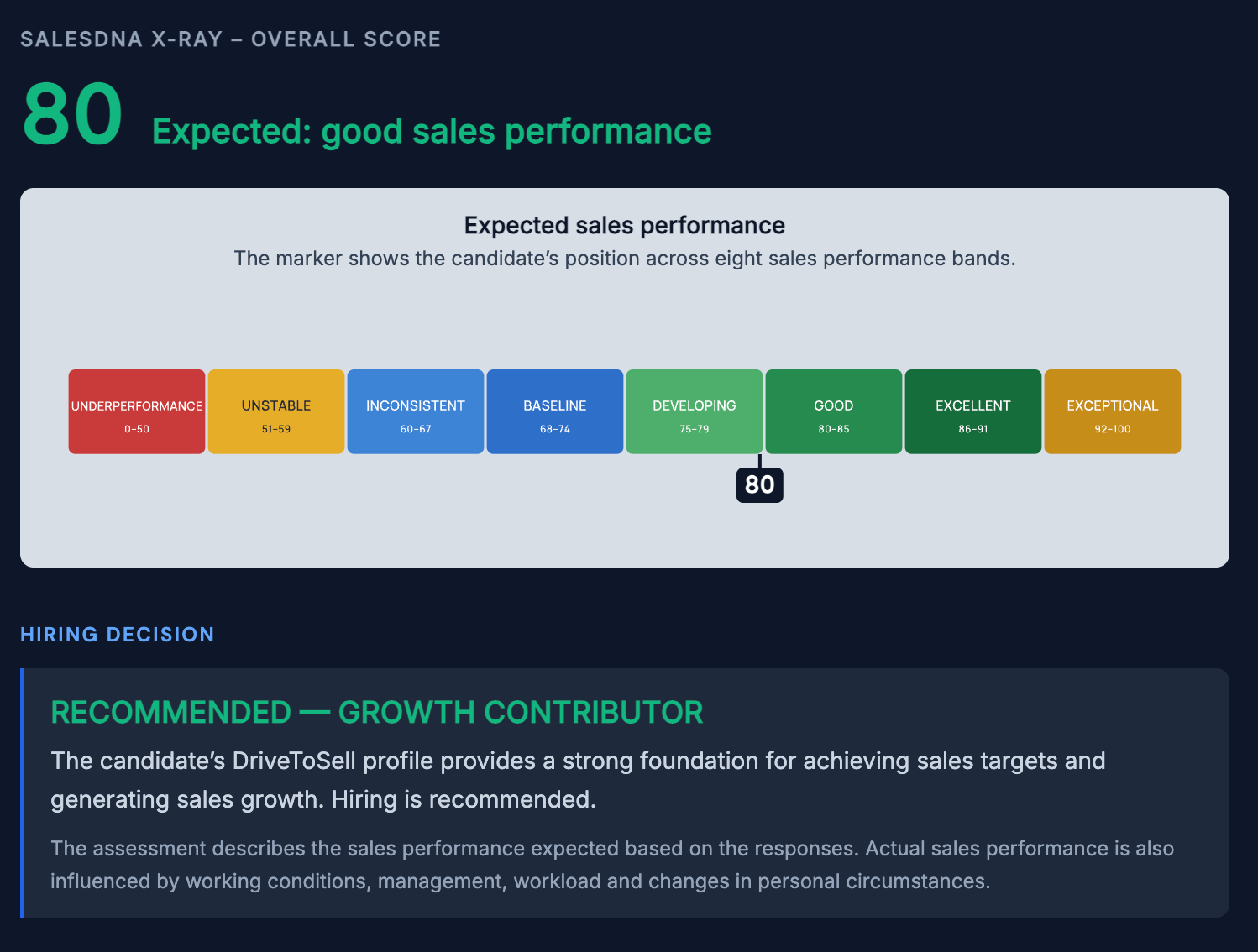
The assessment is interpreted in the context of your company's sales environment.
A salesperson who succeeds in one sales environment may not succeed in another. That is why the assessment is interpreted in the context of your company's sales environment.
Short-cycle consumer sales require different ways of working from long, multi-stage B2B sales. Winning new customers places different demands on a salesperson from developing existing accounts.
The assessment takes into account:
- the sales role
- the B2B or B2C environment
- the length of the sales cycle
- how sales are brought to a decision
- the activity, follow-up and follow-through the role requires
The candidate is not assessed in isolation from the work.
They are assessed in the context of the role in which they need to deliver results.
How SalesDNA X-Ray works
1.
Send the role details and the people to assess
Email the sales role description and the names of the people to assess to kim@salesdnaxray.com. We agree on the assessment purpose, report type and who sends the invitations. If SalesDNA sends the invitations, also provide the recipients' email addresses.
2.
Each participant receives a personal invitation link
You can forward the invitations yourself or ask SalesDNA to send them. Each participant reads the instructions and completes the questionnaire. An interrupted questionnaire can be resumed using the same link while the invitation remains valid.
3.
Open the report from your employer link
The pre-screening report includes the score, recommendation and key reasoning. The full report also includes detailed findings and management and coaching guidance aligned with the recommendation.
4.
Verify the shortlisted candidate in the interview
Use the interview questions from the full report. Review previous results and the competencies required for the role.
5.
Make the decision and plan the start
The assessment supports the hiring decision. The management and coaching guidance for the selected candidate is used to support onboarding.
What do you get to support your decision?
- an overall assessment of the candidate's sales performance profile
- an interpretation in the context of the role and sales environment
- the main factors supporting sales performance
- the key sales performance risks
- clear points to check in a follow-up interview
- a HIRE / DO NOT HIRE recommendation with reasons
- a consistent basis for comparing candidates
- information to support the selected candidate's onboarding and management
Less guesswork. A better basis for your decision.
International research. Practical validation.
The DriveToSell model underlying SalesDNA X-Ray combines international research on sales performance with practical evidence gathered in Finnish sales organisations.
The model draws on extensive international research into predictors of sales performance and the relationship between optimism, responses to setbacks and sales results.
Reported classification accuracy in our own MyyntiDNA validation
90–100%
Underperforming sales performance
80–90%
Unstable sales performance
Approximately 80%
Other sales performance levels
Assessment results were compared with actual sales results and management observations across different industries and sales models.
The aim is to identify expected sales performance and material performance risks — including those that past sales figures or a strong interview may not reveal.
Source: MyyntiDNA & MyyntiSyke – Validation 2026. The accuracy figures refer to our own validation dataset. International studies inform the selection of the model's underlying factors; they do not constitute a separate validation of SalesDNA X-Ray.
Skill tells you what a salesperson can do. DriveToSell™ determines what they get done.
Skills matter. But having skills is not the same as delivering results.
Results come when a salesperson uses their skills consistently, handles setbacks, takes responsibility for their work and follows through.
SalesDNA X-Ray measures DriveToSell™: the drive and readiness to put one's skills to use to meet sales targets.
A strong CV tells you about the past. SalesDNA X-Ray helps you see what you can expect from a candidate in your sales role.

Kim Koskinen
Creator of SalesDNA X-Ray · Sales Solutions Finland Oy
I have worked in sales, salesperson recruitment and coaching for more than 20 years. My experience includes more than 3,000 salesperson recruitments and over 800 joint customer visits with salespeople.
I am a salesperson myself and have had the opportunity to work with leading international sales and sales training professionals. That has given me a benchmark for exceptional sales performance and a practical understanding of what it takes to achieve it.
One question has interested me for a long time: why does one salesperson achieve several times the results of another in the same environment — and how could that difference be recognised before the hiring decision?
I developed SalesDNA X-Ray from this work. It combines my practical experience, research on sales performance and my own validation data. My aim is to help clients assess whom to hire, what they can realistically expect from a salesperson and what kind of management that person needs to succeed.
I am driven by constant curiosity: how could things be done better? I live by the kaizen principle — learning, experimenting and making small, continuous improvements. The same thinking guides the development of SalesDNA X-Ray. Research, client feedback and actual results help us assess which changes really improve the product.
Outside work, music has always been an important part of my life. The gym gives me strength and energy for everyday life.
See beneath the surface.
Make a better hiring decision before a poor hire costs you too much
SalesDNA X-Ray is for CEOs, sales directors and sales managers who want to understand a candidate's sales performance profile before making the final hiring decision.
SalesDNA X-Ray also supports the assessment of existing salespeople. It helps identify strengths and risks affecting sales performance and focus management and coaching where they are needed. Ask about assessing your own team.
Let's discuss how SalesDNA X-Ray could support your next sales hire.
After you get in touch, we will arrange a short conversation to discuss your situation and assess whether SalesDNA X-Ray is a good fit for your next sales hire.
Send us the number of people to assess and details of the sales role.
We will confirm pricing and delivery before you place an order.
kim@salesdnaxray.com
Interested in a pilot for your company?
Would you like to try the assessment with a small group before a wider rollout?
Let's agree on the pilot's objectives and scope.